Good evening, everyone. What a moment for all of us.
Thanks so much for coming, especially when thousands of people are returning home, after months of hungry assembly crowded around this building, looking to the rooftop for signs.
At 4:30 pm, December 4, the fumata bianca, the white smoke, emerged. President Will Dudley has been selected.
What an inspired choice. I can’t think of a better leader in higher ed today to serve as the 6th president of Claremont McKenna College. Claremont roots. Math and philosophy major. Two-sport student-athlete. Philosopher, scholar, experienced academic leader of the highest caliber at the country’s best institutions. Integrity. Strong character. Brilliant mind. A kind and thoughtful person.
And as Sharon reminded me yesterday, I didn’t even have to die!
You’re still stuck with me this evening.
in sum
My brief tonight is simple.
The state of the College is strong.
We lead without peers across many dimensions.
My question: What drives us? What is the generative core of our strength?
My premise: The key to our success lives within each of us. Understanding that core is key to our future success.
My goal: To excavate, surface that inner learning. To shine that mirror unto ourselves, to shed that light on the flight plan of our steep trajectory.
My challenge: How to weave a fragmented stream of pictures into a coherent, 25-minute film.
When I was a student in the Soviet Union, I was invited to the filming of a banned movie. Before it started, the director got up and explained that the KGB would not allow the entire film to be shown, only fragmenti. So, they took the film, spliced it, created artificial countdowns in between scenes, (4, 3, 2, 1), and then projected the entire film. Soviet ingenuity in avoiding the censors.
My constraint tonight is not the KGB, (as far as I know); it’s time. So, I only have fragmented highlights tonight and hope you will forgive the omissions and see the continuities.
gratitude
Before I piece this together for you, we celebrate.
We raise a glass to all we’ve achieved this year, with overwhelming gratitude tonight.
I am so thankful to Ken, the Board, the Presidential Search Committee, for stewarding this process, culminating in today’s big announcement.
Special thanks to Bruce Soll for his unwavering dedication. He wanted to put off surgery for a day just to be here and was on Zoom earlier from his recovery room. He so wanted to be here tonight. So, this is dedicated to him.
So thankful to the President’s Cabinet, the hardest-working, most effective leadership team in higher education.
To Heather’s outstanding leadership and our brilliant faculty for your triple threat commitment to path-breaking scholarship, student-centric pedagogy, and servant leadership.
To our students for your incredible drive to learn and lead. Sam Johnson-Saeger, our latest Rhodes recipient, CMC’s third in just five years (Sarah Chen, Bertha Tobias), and so many students here tonight who lead our key programs, who dedicate their studies and leadership to provide a better life for others than the one they had growing up, who prove the possible. I see future CEOs, a press secretary and editor-in-chief, a couple of human rights lawyers, a governor and two senators, a Minister of Education for Kenya and President of Somalia, just to name a few.
To our dedicated, tireless staff, in which Nyree has fostered an unparallelled, strong morale.
To Kirsti and Dylan, Anderson and Angie, Bon Appetit at the Robert Day Sciences Center and the Ath team here tonight (including Ashley and Chito), for taking such good care of us (and one another).
To Dorothy, who has been a powerhouse of support in all my preparations, including the special program and artwork.
To Priya.
We celebrate our 35th wedding anniversary this April.
37 years ago, I cut in line at a December class potluck to meet her.
That social infraction was the best decision I ever made.
I can tell you I would not be standing here without her.
Even more importantly, Theo would not be an 8th-year super senior here at CMC, either!
This must make me the luckiest man on earth.
And being here with all of you tonight, to celebrate all we have achieved together, to toast the promising future we share,
I know that makes me the luckiest college president in the world.
pot of gold
In three days, it will be 13 years since Priya and I parachuted down into the Ath. That 13 years is 13 seconds and 13 decades all at once. A blink, filled with so many stories, so many lessons.
On that evening, Dec 7, 2012, I could not have possibly seen the future.
Some of what we’ve achieved would have seemed to have a zero percent chance of happening, and that’s rounding up.
Actually, on that evening, I couldn’t even see the notes for my remarks. My journal was locked in Harry McMahon’s trunk.
So, I told a story, a fable from my tradition.
We tell and retell special stories because we are the stories we tell. They rejuvenate our lives with fresh implications of what they mean to us.
13 years later (as Emeritus Professor John Roth might put it), how shall I tell the story this time?
At the foot of his wood burning stove in a small shtetl outside of Krakow, a poor, ailing Jewish man awoke from a stunning dream.
He vividly recalled that he had traveled to a gleaming city in Austria and an impressive bridge.
The bridge was guarded by a soldier.
In his dream, beneath the bridge, he found a pot of gold.
He woke his wife to share the story and told her he was setting off in search of this treasure.
Against her protests, he gathered a few clothes and some modest provisions and set out on foot.
A few weeks later, bleary-eyed, horribly hungry, and nearly faint, he spotted the bridge from his dream.
As he got closer, he recognized the soldier from his dream pacing, guarding.
The soldier caught his eye and looked at him with sudden surprise.
He said “sir, I saw you in my dream a couple of weeks ago.
I saw you in your little house in your shtetl.
Beneath your wood-burning stove, there was a pot of gold.”
What can we learn from this fable?
One, we need not look beyond the parameters of our own lives to find treasures within.
Two, without the irrational journey in pursuit of an impossible dream, the entire lesson is lost. Had the poor Jewish man not made the trip, he would never have made this discovery.
Three, these two lessons create a powerful narrative for virtuous cycles of learning and growth:
Through pursuits outside the boundaries of our experience, we develop a greater understanding (by reverse projection) of ourselves.
That inner clarity and confidence in turn give us courage and confidence to take next hard journey.
That night 13 years ago, I remarked that Priya and I had “arrived at your bridge.”
As strong as the College was, we could not have imagined the gold we’d find here in this community, in each of you.
We couldn’t have imagined the treasure we’d find beneath our own stoves.
Within ourselves.
You will each have your own version of this story.
For me, tonight, I see three inner treasures that explain our singular strength.
the Sisyphus in us
our steady acceleration through windshear
our invisible, indivisible heart
the Sisyphus in us
13 years ago, we could not have imagined how insanely challenging the role of college or university president would become.
There’s no job in our civilization which is CEO, fundraiser, entrepreneur, chief academic officer, mayor, chief judge, mediator, Rabbi, talent scout, coach, super-fan, and so much more.
As if God rested on day seven, and on day eight, created the university presidency and then said, “okay, people, take that!”
I’ve loved it, even when I despaired at the toughest points:
the Halloween protests of 2015,
the Heather MacDonald blockade,
the tough departure from Keck Sciences,
the heart-breaking student tragedies,
the pandemic,
the times we got run over by some external political force or powerful misstatement to which we could not respond.
All terribly difficult moments, and yet, each served as an intensifying source of profound learning and growing confidence, an intensifying source, not just of motivation, but of discipline in attacking tough problems.
Oleksandr Usyk, a Ukrainian heavyweight boxing champion in two weight classes, was once asked how he is so motivated to train in super-human ways.
He said, “I don’t have motivation. … Motivation is temporary. I only have discipline.”
And even more than discipline, there’s something more: joy.
Joy in the accomplishments, of course.
More remarkable is joy in the strenuous effort: the persistent drive to surmount nearly insurmountable challenges.
The kind of joy that John Roth lectures about in Camus’s interpretation of the Greek fable, Sisyphus.
Sisyphus was punished by the gods to push a rock up a mountain, only to have the rock roll down and start all over again.
Camus sees Sisyphus experiencing joy in his futile struggle.
In taking on the big challenges, even those that seem insuperable, I believe we all feel that joy, too.
We know we are a molecule in the proverbial drop of water in the ocean, but that doesn’t deter our efforts to keep it from boiling.
Even though we have managed to defy the gods and get some very big rocks up to the summit, we have drawn inspiration from the Sisyphus in us: the inner discipline and joy of taking on the big challenges in higher education.
our steady acceleration through windshear
Yes, at CMC, we have scaled mountains. We are also flying above them.
Just as the mountains are steep and the force of gravity strong, the winds are fierce.
Given the political threats and attacks on higher education over the past few years, many higher ed convenings and panels I’ve been asked to join call for examples of leadership in tumultuous, turbulent times.
Friends, this is not turbulence.
This is windshear: when gale force winds from opposite directions converge.
George Mitchell once said that leadership is about reconciliation of divergent forces in society.
Leadership in higher ed is about the reconciliation of colliding forces.
Here too, as one of the core explanations of our success: we take a page from the instructions to pilots when they encounter windshear upon take-off:
Push throttle to max power (accelerate)
Maintain pitch (do not change gear or flaps) (stay on course)
Ignore altitude loss warnings (avoid reactions that make it worse, keep a steady hand)
Our ability to accelerate through the big challenges, our laser-focus on our mission, and our even temperament and steady hand at the controls are all key to our future success against the colliding forces.
our invisible, indivisible heart
Surviving windshear is not only a question of pilot performance.
It’s also about the strength of the materials, the interwoven carbon in the skin of the plane.
Fun to note that aerospace technology now includes not just a simple vertical/horizontal weave but a diagonal, 45-degree addition, not unlike the design of the Robert Day Sciences Center or our future diagonal mall.
In social terms, the tightness of the integrating weave creates resilience in our social and intellectual fabric.
The origin story of CMC is one of integration.
Integration of WWII Vets through higher ed back into American society.
Integration of liberal arts and leadership.
Integration of disciplines (at the outset, economics and political science).
Integration of rigorous learning and applied experience.
Nearly 50 years ago, the integration of co-education.
Without diluting the specific worldview in our motto, commercio is not just financial exchange, it also extends in Cicero’s writings to social, intellectual exchange.
Civitas is not just civilization. It also signifies community.
The underlying theory of The Open Academy, CARE, the Ath, the intentional integration of the residential and academic experience through community, purpose, and play, the activation of the scholar-athlete-leader model, and so many supportive strategies is to strengthen the inner core of our relationships, friendships, mutual respect, trust, and unwavering support we have for one another.
That is the strength of the weave in our social fabric.
If the invisible hand is an apt metaphor for free commercial exchange in The Wealth of Nations, by Adam Smith, the invisible heart is a powerful analogue for social exchange, from his first work, The Theory of Moral Sentiments
One of the core reasons for our extraordinary success, especially at a moment of affective division and political controversy, is the deployment of this invisible heart in ways that make our community, indivisible.
Academically, this is what Professor Emeritus Marc Massoud meant and represented when he told his students: “if you fail, we fail.”
Socially, this is why friendship is not the cost of healthy disagreement, it is the foundation.
CMC Strong
How have we deployed this generative, inner core—the Sisyphus in us, steady acceleration through windshear, the indivisible heart—to produce the programs, impact, and recognition that demonstrate our singular strength?
In response to the parade of horribles that have corroded confidence in higher education, we have demonstrated the positive deviance of our example in response to higher ed’s big challenges.
divestment in the liberal arts and humanities
Just look at the expansion, depth, diversity, and scholar-teacher prowess of our humanities departments. Professors Eric Helland, Diana Selig, and Paul Hurley spoke of this during the faculty dinner two weeks ago. The faculty has recruited the broadest range of standpoints and backgrounds, broadened the perspectives and learning opportunities of our students in rich and impactful ways. Heather alone has recruited 45 outstanding faculty in just 4.5 years.
Look at the dedication to strong liberal arts pedagogy (big questions, student-centric learning, rigorous evaluation) throughout the College.
The animation of the liberal arts in our co-curricular 11 institutes and centers, with dynamic labs in humanities, policy, civic leadership, and quantitative and computational methods.
The doubling of our PPE program, one of the only in the U.S. taught by full time, tenured professors. One of the only programs in the world that manages to put classical texts to the test of the big controversies of our time.
The transformational summer experiences of the Appel Fellowships, Creative Works, that add to one of the most extensive and generous programs in the world across all sectors and verticals.
weak returns on value and failures in social mobility
Just look at the expansion of our first-gen and Pell grant students, low debt levels, their graduation and post-graduate success.
Our institutional investments in scholarships (The Student Imperative), covering the cost of the full experience (the Kravis Opportunity Fund), building the critical foundation for social capital (the CARE Center and special mentoring programs and student orgs like 1Gen) leveraging real-world experience (The Sponsored Internships and Experiences Program), and the expansion of post-graduate and work opportunities (the Soll Center).
This is why we received a number one rating a few years back from Forbes for return on value and the recent Wall Street Journal recognitions as one of the best colleges in the country for student satisfaction, post-graduate salaries, and social mobility. Our students earn back the average cost of attendance in only 1.4 years after graduation.
politicization of higher education
With an array of related challenges: affective polarization, self-censorship, the deplatforming of speakers, the politicization of higher education, the federal and state overreach in the independence of private institutions?
Just look at the constellation of programs under or aligned with The Open Academy, our development and enforcement of policy, and our disciplined adherence to nonpartisanship.
From the admissions prompt, (now becoming the hottest prompt in higher ed) to the Constructive Dialogue Institute course before arrival, to Vince Greer’s constructive dialogue workshops, to the additional training of first year guides, RAs, and student leaders, and CARE Fellow programs that reach hundreds of students each year, to the liaison work of Open Academy Fellows.
Partnerships with The Dreier Roundtable, Salvatori, Gould, other institutes.
From foundational Ath programs (with no program like it in the world) to Ath Tea and the Salons, where students and faculty gather to address the most divisive issues, to the Model UN Team, with seven world championships and even a large delegation award, the highest national honor possible, last year at the Harvard tournament.
This is why Heterodox Academy recognized the college for institutional excellence in Open Inquiry, and why we were the first college to be ranked #1 for the second time by FIRE for our commitment to freedom of expression.
As Professor Yannis Evrigenis put it in our open forum shortly after the Kirk assassination, “we cannot cede ground to conflict.”
the loneliness pandemic
Just look at our investments here, too. Sharon, DT, and Jimmy have built the most responsive and proactive student life program in the country.
We build community through our social warmth. Open ears, warm shoulders, and, when necessary, tough love.
Through purpose and a commitment to self-authorship, and through play, with a focus on having fun and making lifelong friends: WOA! The Romero Success Coaches, FYGs, RAs, ASCMC, student orgs, student tutors, mentors, and coaches across the institution reinforce it.
Our staff, faculty, and leadership team models it.
This drives results.
Nine out of 10 students feel a strong sense of belonging. Ninety-three percent rely on their friends for strong emotional support.
We have a student body known for its commitment to free expression, a love for robust debate, and commitment to solve problems.
As Paul Hurley told me 13 years ago, unlike students at other liberal arts colleges, our students want to do more than just study poverty, “they want to end it.”
Most remarkably, our students have been recognized by The Princeton Review as #2 in politically most aware, #3 in frequent interaction across race and class, and #1 in friendliest.
We may be the only academic community in the world that succeeds in building a virtuous cyclical relationship between friendship and difficult conversation.
the death of the amateur
The professionalization of youth sports. The commercialization of college athletics.
Here too, we are a positive deviant in this negative trend.
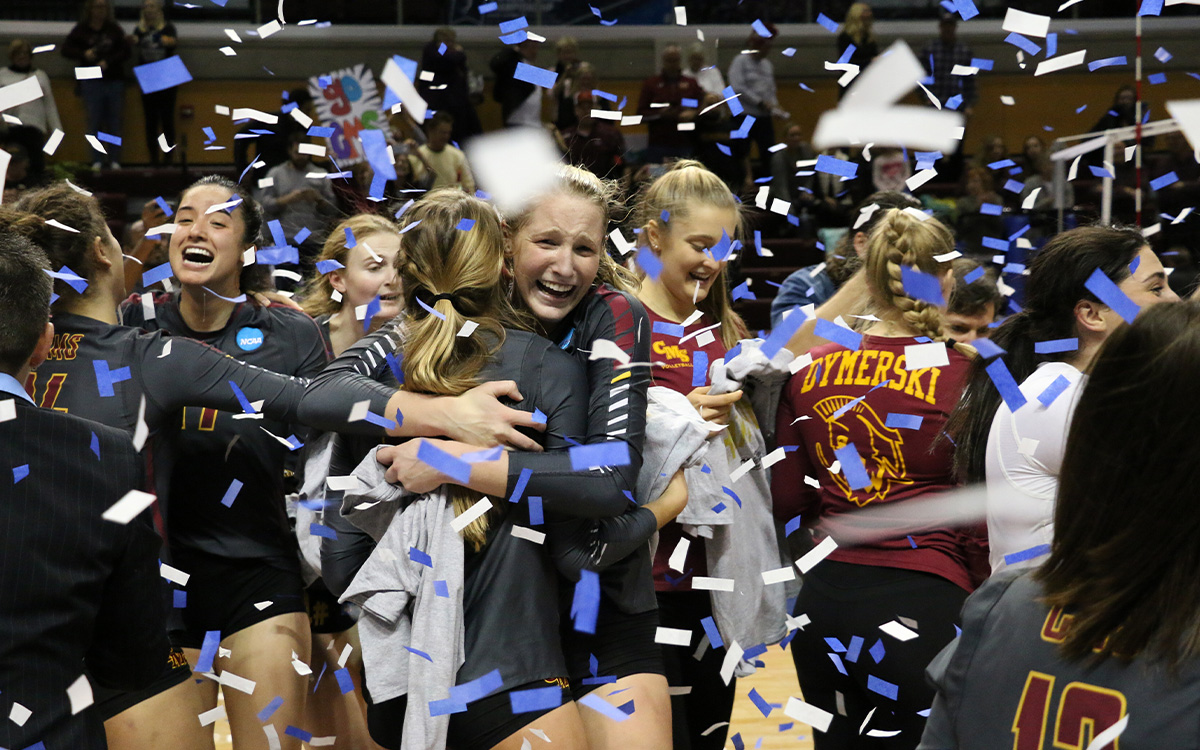
Just look at the success of our Scholar-Leader-Athlete model and eight national championships and top Learfield Director’s Cup rankings each year.
Exemplary students, who learn, lead, and compete in a triple threat that is far too rare today. This includes several outstanding athletes here tonight, from our #3 women’s cross-country team and our #1 ranked men’s water polo team, who won the D3 championship this weekend. Our two basketball teams have only lost a total of one game so far this season.
Ella Brissett, the awardee of a Division III student-athlete of the year honor, and a current nominee for the top NCAA student athlete of the year, across all divisions, is a notable exemplar of a larger success story here. Peer-review science publications, thesis award, founder of a women’s sports leadership organization, two-time All-American, two-time national champion in doubles.
AI and over-specialization of science and computation
Will AI make us smarter or dumber? More curious or lazy?
From Amy Kind’s Gould Center programs on AI and creativity to the efforts of an AI leadership group from every department, we are taking this challenge head on.
Focusing on the development of human intelligence, literacy and fluency in AI, and responsible, ethical applications across all disciplines.
Just look at the early success of the Kravis Department of Integrated Sciences.
No departments, three grand challenges (Health, Brain, Planet), even the very first course, Codes of Life, required for all to take: problem-based, just in time learning, independent research, coding, the creation of an AI generative system, team-work, integrating economics, policy, ethics in presentations to public authorities.
Bolstered by the phenomenal work in psychological sciences, philosophy of health care and computation, math and data science and the Murty-Sunak Quantitative and Computing Lab.
Inspiration for imminent intensifications of integrated humanities, integrated policy, integrated finance, and other interlocking disciplines.
the chronic, ailing capital plant
Just look at the current campus, the spectacular home for the new Kravis Department, the most iconic facility in the entire region, the Robert Day Sciences Center.
Regarded as one of the 10 most significant buildings in the U.S. in 2025 in Dezeen Magazine, with many more accolades from architectural publications under review, from the Los Angeles Times to Architectural Digest.
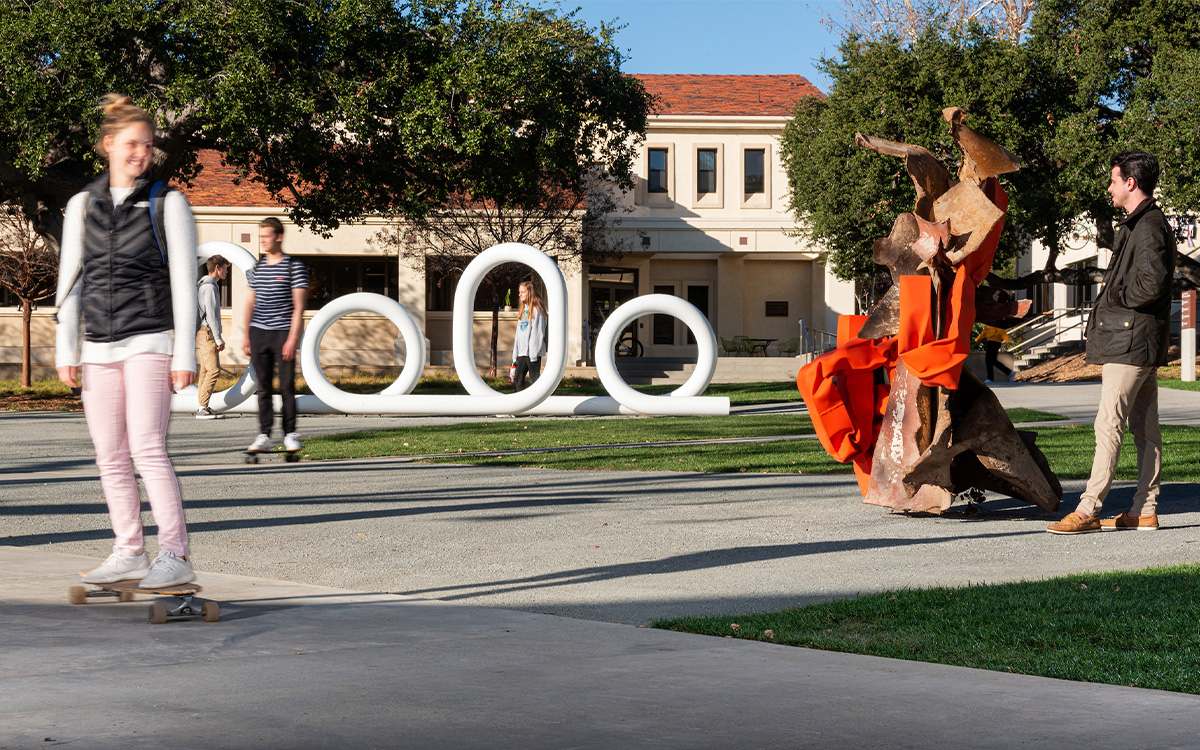
Our outstanding Walker Public Art Collection, with over ten phenomenal pieces, including two not yet installed, Rapunzel by Anne Shechet to be place just outside the Day Center and Tsunami by Anish Kapoor (which will be featured in the next academic building, Records Hall (the new home for RDS); an extended North Mall (east of Bauer), followed by a diagonal mall from the Day Sciences Center to Roberts Pavilion.
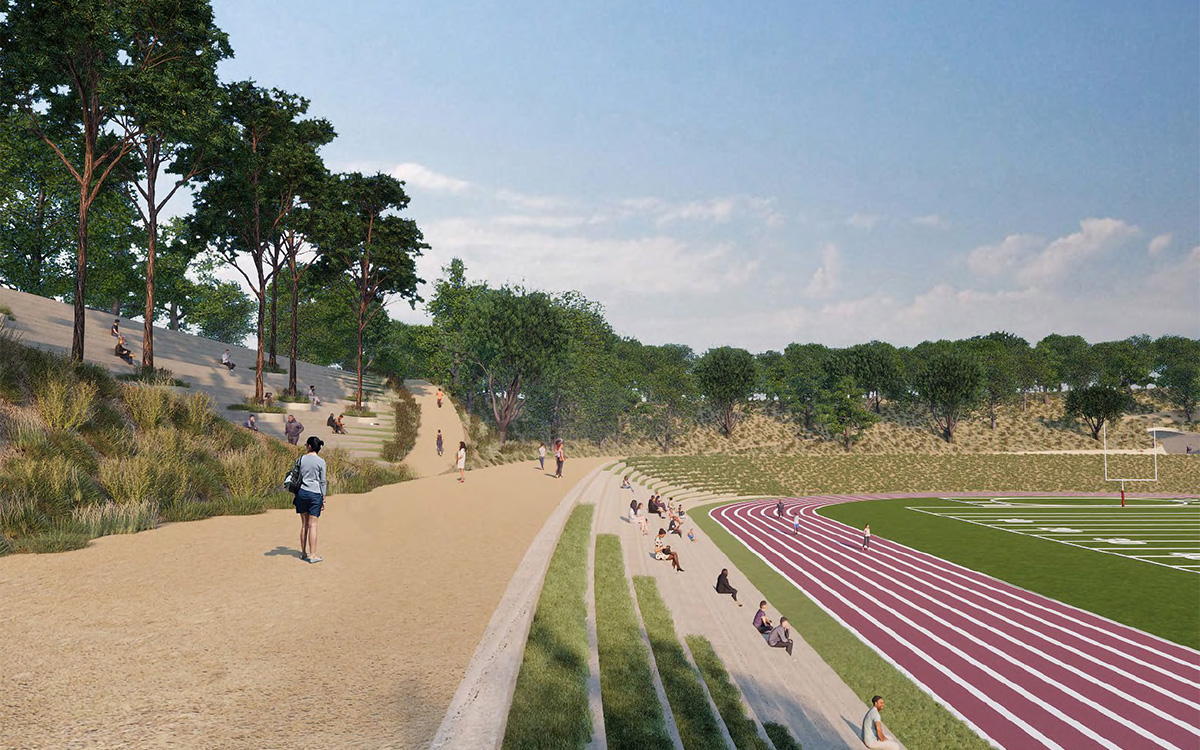
And just watch what we’re doing with the doubling of the campus footprint and the addition of the Roberts Campus and the Sports Bowl, with construction currently underway for the arcade and additional parking, a new stadium and state of the art facilities for football, track, lacrosse, baseball, softball, golf, and ROTC.
Anchored by the Roberts Pavilion and the Biszantz Center, we were recently ranked first in sporting the Best D3 athletic facilities now, even before the completion of our new Sports Bowl.
financial instability
Just look at our balance sheet.
Strong demand for our program. Strong return on value.
Our investment group has been in the top 10-12 percentile in the past one-year and five-year periods, doubling our endowment.
During the last three years of the record-setting $1.1B campaign, we raised more $ per student than any other college or university in the country, coming in 2nd only behind Icahn Medical School.
Our young alums contribute at the highest rate of participation in the country, a reflection of student satisfaction and the commitment to pay it forward.
In 2021, we issued a century bond at a 3.775% coupon and have put some of that treasure away in a defeasance lock box that will help secure the College’s financial future for centuries to come.
The discipline of our Board and the College leadership team has built out our programs and facilities, with 100% philanthropic funding, including set asides for the future care of our student body and the campus in which they thrive.
This year, our fundraising efforts have already doubled our annual goal within only six months. Even in this year of transition, I seek to make this the best fundraising year in CMC history.
Here too, we have received a breadth of strong recognition for our financial prowess and management, with an A-plus in financial strength in Forbes, at the top of the other 33 institutions listed with that grade.
Our very own Fred Prager, one of the giants of higher ed finance, believes we are on the road to triple AAA status.
In sum, eight big, challenging questions. Eight sets of powerful CMC answers.
the uncertain future
I can say with unwavering conviction: the future for CMC is now.
The answers are here, and each well underway.
Here we lean into the most powerful approaches to what we already do best.
One (to achieve even deeper integrations of the liberal arts curriculum)
Integrated humanities. Integrated policy. Integrated finance.
All to riff off the accomplishments of integrated sciences.
Not siloed verticals but interlocking disciplines and learning experiences.
Two (to build on the success of our institutes, centers, and labs)
Project- and problem-based learning across all disciplines, through advanced research, projects for external partners in humanities, policy, data science, finance, science, technology, and new entrepreneurial enterprises.
Three (to attract the best young leaders to us, without barrier):
On- and off-campus Open Academy, constructive dialogue, leadership programs for K-12. Structural changes in how financial aid is calculated, how the cost of attendance is priced and communicated well in advance of the application cycle to achieve more transparency, predictability, fairness, access, and affordability.
Four (to establish CMC as the premier global liberal arts leadership program)
Internal workshops that consolidate, cross-leverage, and amplify leadership in our community:
Here are two.
CMC Leads, a gathering of hundreds of alumni, parents, students, faculty, staff at the end of April, co-hosted by two of our most transformative alumni, Henry Kravis and George Roberts, who in a rare, special appearance on campus together, will tell their leadership stories on this coming April 25th.
Our upcoming anniversary, 50 Years of Co-Education, a celebration of women, leadership, and impact, past, present, and future, at CMC, and in the world beyond.
Additionally, national and global workshops at CMC, partnerships, like George Thomas’s Salvatori seminar and Adrienne Martin’s PPE exchange program at Oxford in 2026, and collaborations that disseminate our strategies, democratize our success, with the upcoming FUSE conference (Future of Undergrad Science Education) in mid-April as a powerful example, as well as our large Open Academy collaborations with leading nonprofit organizations.
Now you can now see why the discipline and joy we derive from the Sisyphus in us, our steady hand to accelerate through the storms, the integration of our invisible, indivisible heart, are so core to our strength, our success, our future.
Now you can see why I’m the luckiest president on earth, why I’m going to miss these and innumerable other moments with all of you. why I feel so fortunate to be stepping down from this role at the College’s strongest and most promising moment and when Priya and I feel our absolute best.
I’m excited to hand over the most desirable presidency in higher ed to an outstanding academic leader in President Will Dudley
to push bigger rocks to the summit,
to put a steady hand on the throttle of CMC’s race into orbits beyond our current imagination,
to nourish the indivisible heart that pumps blood into all we do.
two requests
Before I close, I have two requests of each of you in this presidential transition.
One, please give me the responsibility for anything we have not yet achieved, and take the credit you each and all deserve for every single individual and collective accomplishment.
Two, do not look for Presidents Benson, Stark, Gann, or me in the new president Will Dudley.
Look for the best of him in you. Look for the best of you in him, just as you have for me.
He will have his own dreams.
Give him the provisions to embark on difficult journeys.
Now I know you will be guarding CMC’s bridge, protecting our mission, ensuring all we have built continues to thrive.
But here I want you to see the treasure in Will’s eyes, too.
Guide him back to the gold underneath his own stove.
That’s how we find the Sisyphus in us to keep climbing, the steady hand to accelerate through the countervailing winds, the indivisible heart in mutual, unwavering support.
That’s how we discover the treasure within.
Thank you all.
Happy Holidays.
Love, peace, health, joy to you and yours.