

Sandy Mackie ‘67 holds the distinction of having served exactly 89 days of active military duty. Under a 1970’s Active Duty for Training program designed for Lieutenants who had deferred service after graduation to attend graduate school. Enrolled in the ROTC program, Sandy graduated from CMC in 1967 with degrees in economics and political science and commissioned as a second Lieutenant but deferred active duty to attend law school. He was called to active duty in October 1970 upon completion of a law degree at The National Law Center George Washington University and traveled to Ft. Eustis, Virginia to begin training as a Transportation Corps Officer. His Basic Officer training classes spent mornings learning how to load and deploy trucks, trains, and boats with afternoons accompanied by some vigorous physical training. By this time, the Vietnam war had started to wind down and the need for junior officers with minimal experience was limited. On his 90th day, Sandy’s unit was marched out the front gate of the base and was told “your service is no longer needed.” If the officers remained past 90 days, they would have been eligible for military benefits which ADT was designed to avoid. Thus, Sandy became a 90-day wonder assigned to a Reserve Computer Division in St Louis with the understanding that if they called, he would have to come. In June 1975, eight years after his commissioning, with no intervening request for active or Reserve duty, he was called to Walter Reed Army Hospital, given a physical and received his discharge papers.
The lack of actual service did not diminish the importance of serving for Sandy, if only on a limited basis. Both of his grandfathers were officers in WW I. His father, Alexander “Sandy” Mackie, was killed on Iwo Jima five months before Sandy was born, and his Stepfather, Chuck Dosskey, an Army Captain with service in the Aleutians and Okinawa, provided a family ethos that military service was important. An Uncle was a Mustang in the Navy at the start of WW II and later the base Commander at Subic Bay in the Philippines during most of the Vietnam War, added to the family’s military background surrounding Sandy’s childhood. Although a sole surviving son and ineligible for combat, there was no question that he would join the military tradition at whatever school he chose to attend.
How he came to CMC was a bit of a fluke. An advisor had given him a copy of Heilbroner’s “The Worldly Philosophers,” a short biography of historic economic thinkers, piquing his interest in economics and supporting his underlying desire to be an attorney. His advisor, from the University of Chicago, saw that Sandy was well versed in the benefits of the University of Chicago from both an economic and legal point of view. Sandy was programmed to go there. Needing to find an excuse to get out of a physics lab one day, Sandy stopped into a meeting at the Lake Oswego OR High School Library where a CMC group was giving a presentation on the Claremont Colleges with an emphasis on CMC. Small classes, a focus on government and law were interesting to the point that Sandy applied to CMC out of curiosity. Still, in his mind, he was headed to Chicago. That winter a neighbor, who attended Northwestern University, learned of his interest and showed Sandy the heavy overcoat he had to wear in Chicago’s cold winters. The coming spring, as acceptance time rolled around, having already filed out his acceptance to Chicago, and in a fit of 18-year-old logic, he thought about small classes and warm sunshine, changed his mind and in the early Spring of 1963, sight unseen, sent his acceptance to CMC.
September 1963 saw Sandy leaving the Pacific Northwest for the first time as well as first time on an airplane (a DC -3 with at least a half dozen stops between Portland and LA.) He arrived at Campus knowing no one, having forgotten the groups that made the presentation the previous fall.
At CMC he lived in “New Dorm” later named Benson Hall for two years with Les Waite ‘67, then Beckett and finally Berger Hall with Steve Griffith ‘67. He signed up to be an Econ major and with the added benefit of a waived foreign language requirement (four years of high school Latin) settled into what was to be a challenging and enjoyable four-year journey to a double major in Economics and Political Science. (As a side note, Sandy believes it was cruel and unusual punishment to schedule Calculus on Tuesday/Thursday/Saturday at 8 am—his worst class at CMC.) Sandy found he was more interested in the practical rather than the theoretical side of his subjects (to describe a graduate school class on econometrics as boring is to give it too much credit). Economic theory and vocabulary on the practical side, however, gave him a way to view the world in terms of actions and consequences. As Professor Thomsen so famously noted on the first day of class: The larger the island of attainment the longer the coastline of desire. The marginal utility pressures that were applied both to business and political endeavors led Sandy to a series of classes looking at how the world was organized and worked at the practical level (i.e., Administrative Law as you get to law school).
Basketball and ROTC were the “outside activities” that occupied most of his day util the fall of 1966 when he met Cindy Hoyt (Pitzer class of ’69) whom he was to marry two years later. Professor Winn Fisk was his advisor on post-graduation and graduate school and suggested he consider Washington DC as that is where administrative law is centered in the country. Sandy attended the National Law Center at George Washington University and did well ultimately serving as the Topics Editor of the GW Law Review. Professionally and another stroke of luck (dodging a securities class by taking a government contracts class), he had the good fortune to clerk at one of the premier government contract firms in the country, Sellers, Connor & Cuneo. Serving even as a clerk in a firm with major contract cases gave him a realistic inside look at the military industrial complex and the ins and outs of government contracting.
Warned early on that: “contract are contracts, don’t let the numbers scare you,” first project was to see who in the government had a warrant (authority to spend money) to resolve a claim for cost overruns the C5A, Shram Missile, and an advanced helicopter that had the bad habit of excessive flexibility in rotor blades. The excess costs due to changes and bad specifications were over $600 million, and the short answer was that no contracting officer had the authority to write that big of a check.
Upon graduation Sandy had expected to return to uniform to complete his military service. In the Spring of 1970, he got a lengthy letter advising him of the opportunities in the JAG Corps (Judge Advocate General). Very few graduating attorneys had any background in government contracts, and by chance one of the attorneys Sandy got to know during law school was on the Armed Services Board of Contract Appeals. That attorney noted there was a real need for young attorneys with Sandy’s experience serving the Board, and the request was made to the JAG group about a potential assignment. With military precision, the JAG officials replied “no special assignments were available” even with his special background Sandy’s first assignment was likely to be a JAG Officer in Korea.
The letter's last line noted that if a suitable four-year assignment was not found, he was to report for ADT. ADT as it turned out meant “Active Duty for Training.” This was a 90-day program to prepare a reserve of officers who could be called up in the event of a need to take the burden off National Guard troops should they be called to serve. Sandy’s 90-day service story, presented earlier, was the completion of his active duty. As such Sandy was Veteran having served on active duty but discharged before completion of the full 90 days required for benefits. Having come from a long line of veterans, however he was proud to serve, even as it turned out on an extremely limited basis.
Returning to Washington DC, in 1970, he had further experience in major government contract disasters from the Mark 48 torpedo (can you really meet specifications for a major weapons system designed by a primitive computer?), to the Secaucus Bulk Mail Facility construction project (a William Proxmire’s winner of the “golden fleece award two years running for being 100% over budget and two years late in an era of 1.5% per month inflation.)
When his son was born in 1974, Sandy and Cindy decided his constant red eye travel and life on an airplane was too much and they moved to Olympia, Washington in 1975. The Prosecuting attorney hired him to help the County build its new courthouse, later in his own firm - Owens, Davies, and Mackie. In the mid 1970’s through the 1990’s, environmental regulations were a new and growing field of government regulation. Sandy was an early author in the field writing the original “Short Course” for local planning in 1976. He spent the next decade working in and teaching the assumed benefits of planning, environmental protection, and shoreline regulations in Washington State. While the objective of planning efficiencies held promise to meet the demands of a growing population; over time the political forces exercised control over the process with a variety of personal agendas, from increasing public transit and public housing, to giving ever more protection to environmental sensibilities and limiting urban growth boundaries to try and control growth. On paper these efforts were claimed to accommodate growth but as managed in fact they fell well short of that goal resulting in higher costs and less development leading to many of the urban issues we have today.
In 2012, nearing retirement, Sandy was the designated Executive Editor of Volumes 5 (Planning) and 6 (Land Use Development) of the Washington Bar Association Real Property Desk Books Development. While a recognized expert and successful at all levels of litigation in the land use field, he became critical of a system which resulted in over regulation, and vague and arbitrary application of environmental rules. It also left an open door for frivolous litigation and left Washing State, along with its cohorts Oregon and California as three of the states in the country where planning and government regulation were faced with a myriad of conflicting and often inconsistent priorities that abandoned all the early objectives for which the planning rules were initially adopted.
The practice of law was a great career, but as Sandy says, “The practice of law is all hot air and paperwork with little that is personally tangible to show for significant effort. One’s victories show up in your client’s success. And whatever the results, they are always criticized saying your conclusions were wrong—even when upheld by the courts.”

Sandy’s life has not been all work and no play. Finding physical release, he was attracted to building and woodworking. In Virginia, he built a riding stable near the small developing community of Reston, VA, where his wife managed a small riding stable. “Little Run Farm,” named for the small creek running through the property, is now memorialized in a small street in the subdivision built on the property after they left. Upon moving to Olympia, Washington, he continued helping Cindy build facilities to continue her riding and teaching. Today “Hunter Mill Farm” is named after the street they lived in Virginia.
Sandy and Cindy have two boys, Alec, born in 1974, and David, born 1985, who enjoyed life on the small farm in Olympia and grew to be successful in their own right. Alec, after a brief stint at the LA times, became Communications Director for the wastewater association of California and now consults in the field. David and his wife Bonnie majored in theater in college and in their early life worked the theater scene from New York to Europe and beyond. Tiring of the travel, they relocated to Washington State where they have an organic farm serving a number of the farmers markets in the Seattle area. David likes to keep his hand in the theater, however and if you happen to be in New York at Christmas and take in the Cirque du Soleil l show, you will see lighting credits to David Mackie.
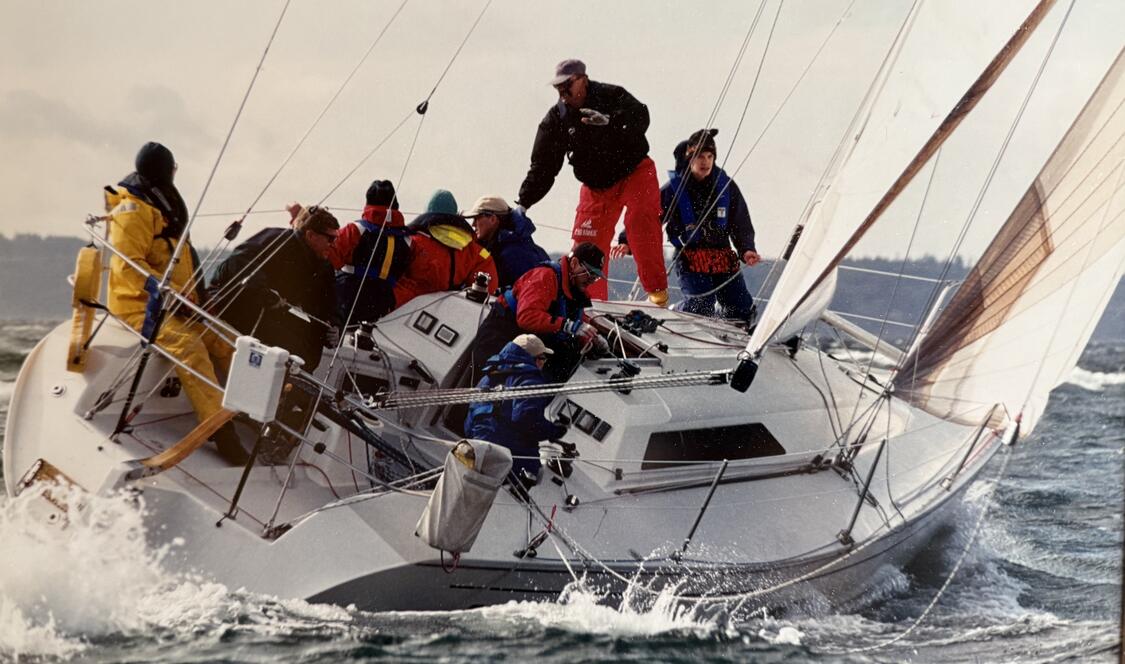
In Olympia, Sandy returned to his interest in sailing and was involved in racing and cruising sailboats for over 35 years. Active racing was demanding of his time as local races were held weekly with major races up and down Puget Sound and British Columbia, monthly from October to June. Non-race weekends spent keeping the boat and gear in top racing condition. His boats include “Solings,” an early 70’s Olympic Class, then “Olson 30’s”, an early ultralight, then a “Tripp 33” named “Short Circuit.” This was a boat twice named in the top 25 racing boats in Puget Sound in the late 19990’s. Finally, a “J 35” owned by a friend where they shifted from handicap to one design racing. During summers Sandy and his family spent more than 20 years cruising the waters off Vancouver Island and Puget Sound,
As racing waned, his foredeck son graduated and went to college, Sandy’s interests reverted to woodworking where he built a small dory used in the lakes and marine waters around Olympia and, once he had moved to the east side of the state, he built a small wagon used by the Packers in their local parade. He also built back porch tables, and other useful items around the house.
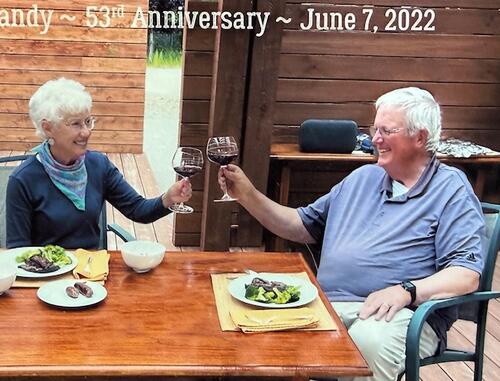
Sandy and Cindy retired to Winthrop Washington in 2009 where they live today enjoying retired life, a bit of golf and woodworking and working with their Pony Willy.
Thinking back, Sandy muses that his greatest strength as a lawyer was “his ability to connect the dots, and to take random events, organize and sort them out quickly. This was an innate skill and a gift.” He comments further that, “At CMC I realized this skill was there. I was successful in reading, writing, and assimilating information. I always tested well.” He admits that Professors Thompson and Fisk pushed him and encouraged deep thought: “They taught me not to accept first impressions but look beyond the obvious to causation and consequence.” This skill helped Sandy to sift through the clutter and harangue of complex public policy questions and move to solutions which could adequately meet often conflicting objectives.
Sandy has two guiding Life Lessons Learned to offer that shaped both his professional career and private interests:
- If you look long enough and hard enough, you will find the answer.
- If you follow your passions, it does not feel like work Sady has two poems on his desk acknowledging the ying and yang of life
To his Father Sandy:
THEY SHALL GROW NOT OLD
AS WE WHO ARE LEFT TO GROW OLD
AGE SHALL NOT WEARY THEM
NOR THE YEARS CONDEMN
AT THE GOING DOWN OF THE SUN
AND IN THE MORNING
WE WILL REMEMBER THEM
From ‘The Fallen”
By Laurence Binyon
To his wife Cindy:
ONCE IN A WHILE
RIGHT IN THE MIDDLE
OF AN ORDINARY
LIFE …LOVE COMES
ALONG AND BRINGS
YOU A FAIRY TALE
26 Anniversaries and counting: